

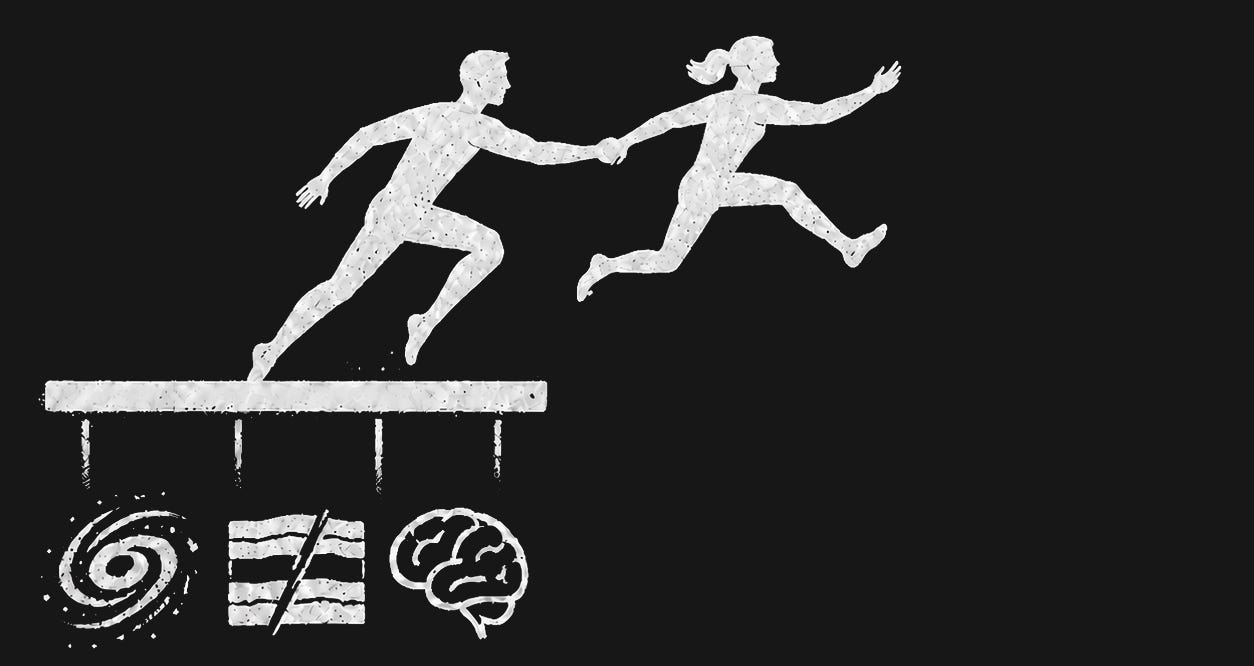
The list of things that we call scientific disciplines today was not inevitable. Had historical events gone differently, divisions might be in very different places. For example, top UK universities such as Cambridge have departments of geography while many elite US universities explicitly divided geography into multiple departments, only some of which they label as science.
Although these divisions have real world consequences in what kinds of work are done and by whom, they also hint at a more difficult but potentially more impactful question: what disciplines don’t exist but could? This question is hard to think about because of how immersed we all are in current paradigms, but that’s exactly why trying to think about it, even if doing so feels like flailing, is important. It’s probably the case that we’re somewhere near the middle of scientific progress and so many of our existing paradigms should be wrong in important ways. This means there’s a chance for this kind of thinking to succeed. Moreover, non-incremental thinking is likely to be an increasingly important domain for humans if you believe that AI will handle a growing fraction of incremental work in the future.
We’ll be the first to say we have almost no idea how to do this in practice beyond continuing to flail, so maybe we need a discipline of thinking thoughts that are hard to think. Nancy Nersessian’s Creating Scientific Concepts proposes that making and manipulating conceptual models while treating them as intermediate could be a real approach here, but this is unlikely to be the only way forward.
Maybe what we actually need is a discipline of how to teach our children to do this. Reading is powerful but doesn’t come naturally. Perhaps conceptual leaping will become the next reading.
We write Reinvent Science to broaden the conversation around science and science funding, and we rely on you to help us reach as many readers as possible. Please subscribe and share to help us continue to reach you and your colleagues.
Reminds me of a paradox.
The Theory of Machines I (TOM I) text defined absolute velocity [of an object on earth] as its relative velocity compared to the earth, i.e., the earth is assumed to be stationary.
Now, this will hold good only so long as we analyze an object on earth relative to other objects on earth.
My point is, we create frames of reference to simplify our understanding and calculations. When the phenomena under study transcend this frame, the understanding and calculations don't hold good.
Guess, the same applies to disciplines.
I suspect that any novel discipline would branch off an existing one or be absorbed by it. In an imagined multi circle Venn Diagram, with each representing a scientific discipline, the central point of intersection would be that each searches for theories of understanding nature based on empirical data and mathematical reasoning. Perhaps one of the most recent novel disciplines is the science of consciousness, which was integrated into brain/neuroscience once tools of measurement or observation, and even attempts at calculating consciousness became options. Before this, “serious” scientists were content to leave consciousness to philosophers.