
Editor’s note: One of the recurring themes here at Reinvent Science is capturing and using tacit knowledge developed by researchers. Naturally, we were excited to have Virginia Emery and Jared Silvia, both scientists who have founded deep tech startups, contribute this piece on the role that tacit knowledge plays in science commercialization. If you’re interested in learning more, they’ve written a white paper on this topic as part of their work at Gliding Ant Ventures.
Only 1 in 4 of the inventions developed at U.S. universities are ever licensed1, and fewer still reach a market. We spend billions generating innovation — academic research expenditures topped $109 billion in 20242 — and then fail to move most of that science the last mile into a product.
The usual explanation is a lack of money or market fit. Another deeper problem is what we call dark matter—the tacit know-how, the failed experiments, the undocumented intuition that lives only in the inventor’s head. A patent is the visible tip; the dark matter is the invisible mass that makes the thing work. Strip it away, and you are left with a document nobody outside the original lab can operationalize.
The data backs this up. Across 50 years of spinouts at Stanford University, the top-earning patents were licensed by the inventor’s startup, and self-licenses were 3x more likely to generate >$1M in royalties3. Inventor-led startups have the greatest commercial success because the inventor is the nexus of the invention’s dark matter.
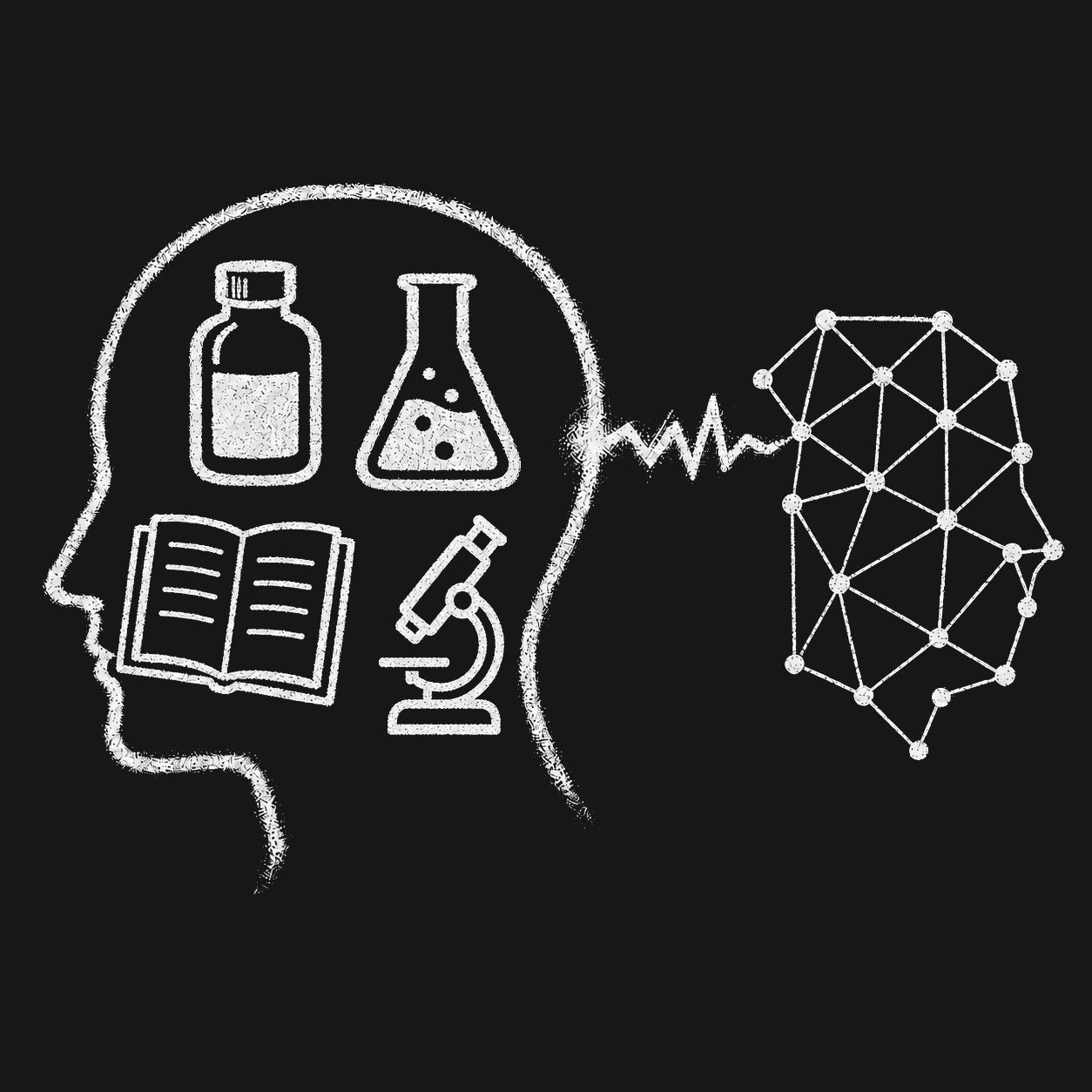
Capturing this dark matter was once thought to be like catching lightning in a bottle, but with accelerating AI, we are beginning to have the right tools. Imagine a digital twin of the inventor: an AI model built by combing through lab notebooks, experimental dead-ends, and structured interviews, then made queryable for the next team. Not a novelty chatbot — a working interface to the reasoning behind the invention. Why did you abandon that pathway? What did you do ‘that one time’ it worked? What would you try next? These answers are available in conversations around the water cooler and lab bench but vanish the moment a team disbands (or a student graduates).
Building a digital twin of an inventor differs considerably from the omnipresent ambitions of building an ‘AI scientist’. Peer-review4 is a far lower threshold to cross than true tech commercialization. Breakthroughs often come directly from mistakes5, unmeasured variables6, and subtle unwritten choices7. A classic example includes the Nobel-winning discovery of quantum dots, which could not be replicated from a new batch of reagents8. Further investigation revealed a single bottle was responsible for all prior successes; it contained trace amounts of oxidized reagents that were essential for producing the successful reaction9. Real innovation lives in the fringes of the wet lab, in the recesses of dark matter in a scientist’s mind – in the undergrad intern’s subconscious preference for a specific reagent bottle.
The opportunity is largest exactly where the loss is worst: in hard tech startup wind-downs, where we estimate 60% of informal IP simply evaporates. A digital twin captured before the lights go out could let the next founder pick up where the last one stopped — instead of repeating a decade of mistakes.
Somewhere right now, a PhD candidate who knows exactly which bottle to reach for is about to graduate — and no one is writing it down. Multiply that by every lab, every wind-down, every “that one time it worked,” and you’re looking at the largest untapped reservoir in deep tech. A digital twin of the inventor is how we finally bottle the lightning before it leaves the room.
We don’t need to wait for an AI that can do science to rescue the science we’ve already done.
We write Reinvent Science to broaden the conversation around science and science funding, and we rely on you to help us reach as many readers as possible. Please support our work by subscribing and sharing.
AUTM Licensing Activity Survey, Association of University Technology Managers (2024). Survey data has consistently shown that only about a quarter of university invention disclosures are licensed or optioned, leaving roughly three-quarters unlicensed. https://autm.net/surveys-and-tools/surveys/licensing-survey/2024licensingsurvey
“The Numbers Behind Innovation: AUTM 2024 Licensing Activity Survey,” AUTM (2025). U.S. total research expenditures topped $109 billion. https://autm.net/about-tech-transfer/autm-insight/autm-updates/the-numbers-behind-innovation
Liang, W., Elrod, S., McFarland, D. A., & Zou, J. “Systematic analysis of 50 years of Stanford University technology transfer and commercialization.” Patterns 3(9), 100584 (2022). https://doi.org/10.1016/j.patter.2022.100584
Lu et al. 2026, Towards end-to-end automation of AI rsearch. https://www.nature.com/articles/d41586-026-00899-w
St. John’s College, University of Cambridge. “A lab mistake at Cambridge reveals a powerful new way to modify drug molecules.” ScienceDaily. ScienceDaily, 14 March 2026. www.sciencedaily.com/releases/2026/03/260313062539.htm
Transfyr company website: https://transfyr.ai
Thomé et al. 2012. Trace metal impurities in catalysis. https://pubs.rsc.org/cs/article-abstract/41/3/979/367298/Trace-metal-impurities-in-catalysis?redirectedFrom=fulltext
Manna L, Odom TW. Profile of Alexei I. Ekimov, Louis E. Brus, and Moungi G. Bawendi: 2023 Nobel laureates in chemistry. Proc Natl Acad Sci U S A. 2024 Jul 16;121(29):e2410357121. https://www.pnas.org/doi/10.1073/pnas.2410357121
Efros, A. L.; Brus, L. E. Nanocrystal Quantum Dots: From Discovery to Modern Development. ACS Nano 2021, 15, 6192–6210. https://doi.org/10.1021/acsnano.1c01399. Accessed at: https://www.columbia.edu/cu/chemistry/fac-bios/brus/group/pdf-files/ACSNanoreview2021.pdf
Can such a digital twin recreate the state of mind of the researcher(s) at a particular instant in time? That particular instant may not exactly be the Eureka Moment but a stepping stone in that direction.
I encountered this feeling when dealing with multi-step or multifaceted math and physics numericals whose solution bordered on the intangible. Sometimes, a numerical you've solved earlier suddenly looks insolvable. You can solve it again by going back to the basics, but that costs time.
Such a digital twin that captures the dark matter (also called tacit or tribal knowledge, I believe) will work wonders.
Thank you to Reinvent Science for letting us share! It's exciting to think about the possibilities that are beginning to open up as we find new ways to combine AI computing resources with scientific research.