

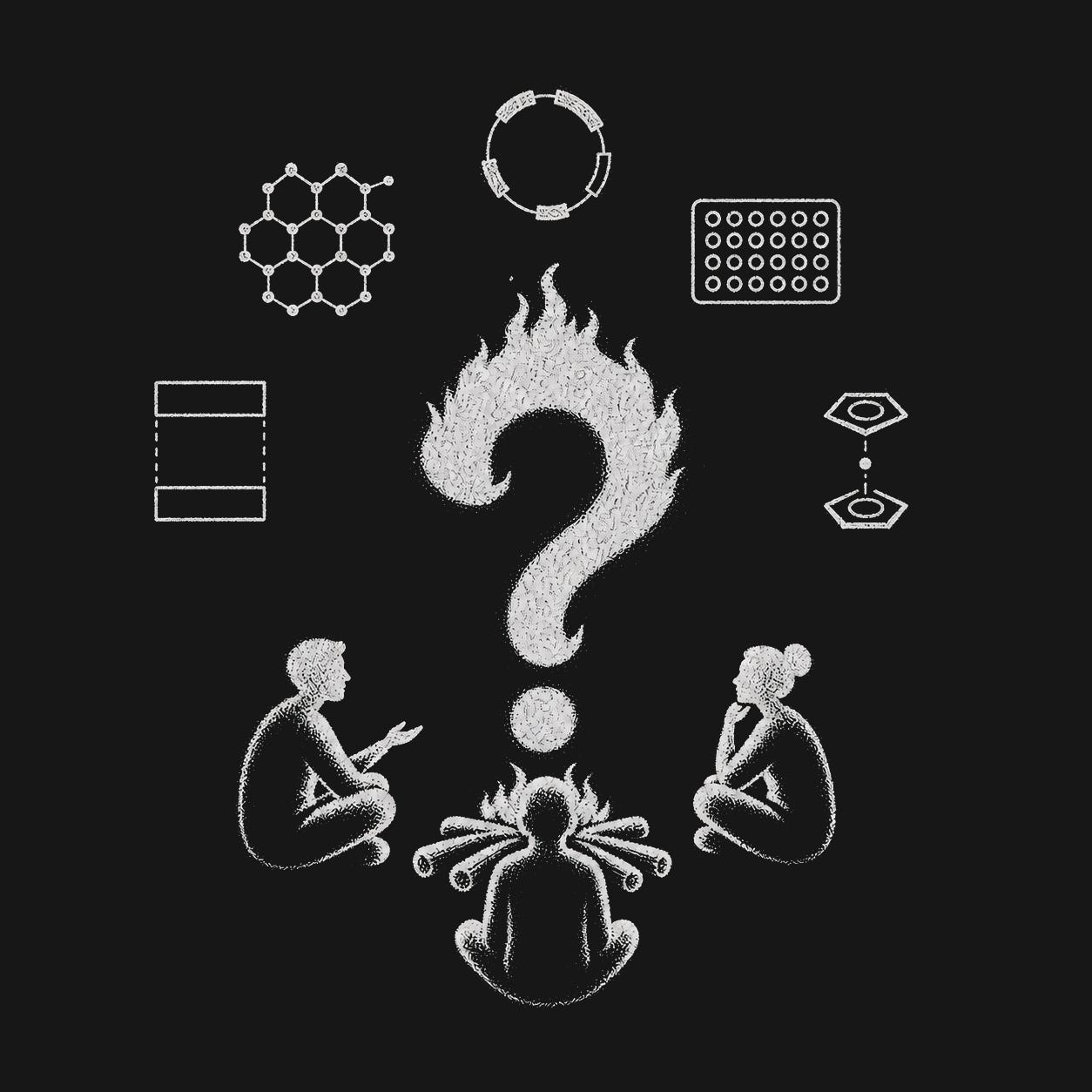
Science is a human activity. We spend our efforts researching the questions whose answers we care about, the subjects we find most interesting, and the technologies we wish we had. Machines can make us more efficient at this work (perhaps orders of magnitude more efficient) and help us prioritize what to work on, but letting them choose for us would cede agency that, for our own sakes, we need to keep.
When parenting, it’s often best to let your child make choices that affect their life even when you know better or think you do. Similarly, even if we expect AI scientists to choose what topics to study better than we can, we should approach that expectation with the humility of a parent who has just been calmly and logically corrected by a precocious 6-year-old (Dan is definitely not talking about his own parenting experience here…). We may in fact always know ourselves better than the best machines we can build will. Even if we do not, it may be a fundamental property of humans that we need to participate in discussions of our fate to accept the resulting decisions affecting it.
AI’s success in formal mathematics is unlikely to be the end of its encroachment on human intellectual endeavors. And so we anticipate that Terence Tao’s recent question to his colleagues1 “What are the precise goals, objectives, and values of our mathematical community, and the enterprise of mathematical research? Not just the explicit goals that we communicate to the public (or to funding agencies), but also the implicit goals that we actually seek in practice?” will soon be relevant to many branches of science as well.
In fields where conducting research turns out to be the comparative advantage of machines, we will need to maximize our ability to choose what to research and to articulate the reasoning behind our choices. Otherwise the overall research enterprise will drift toward market signals, what machines happen to be good at and what they decide we need and in 10 years we might find ourselves with cosmetic surgery technology beyond our wildest imaginations and no progress on cancer research. Even worse, we may let this part of our own agency atrophy and begin to treat scientific advancement as a kind of machine-driven weather.
Back when the Turing Test was still a thing, Brian Chirstian wrote The Most Human Human about his efforts to seem as human as possible to judges who would only see his text output. The book takes a deep look at what we humans think makes us human. Although today we mostly conceive of this defensively (how do I distinguish my writing from AI slop?), there is an opportunity to go on the offense. If we get to the essence of why we ourselves do science, we may be able to out-compete machines at choosing what science matters to humans for many years to come.
“Why do humans do science” is an answerable question, at least for any given historical moment. Though many of us have a gut response when asked why we ourselves do science, we don’t spend much of our empirical effort on the collective question of why science is or should be. Nevertheless, we have the tools to start making progress on this topic though we’ll likely need to invent new tools along the way to get to a satisfying answer. Perhaps a deeper understanding of science as a human practice is the route to healthy human-AI partnership.
We write Reinvent Science to broaden the conversation around science and science funding, and we rely on you to help us reach as many readers as possible. Please subscribe and share to help us continue to reach you and your colleagues.
In Mathematics in the age of AI https://teorth.github.io/tao-web/slides/age-of-ai-icm-2026.pdf
Why do we do science?
For me, science has two purposes:
1) Material: Understand nature to improve human life. Electricity, vaccines, antibiotics, the steam engine, and semiconductors, for example.
2) Spiritual/intellectual: Satisfy our curiosity, i.e., get to the bottom of it regardless of immediate practical benefit. Evolution and the understanding of the universe (partly, of course), for example.
Terence Tao's warning and the observation on the direction of science (cosmetic vs. cancer research) remind me of:
1) My obsession with mathematical expressions as an engineering undergraduate, sometimes at the cost of practical understanding. This was exemplified by the concept of entropy and its mathematical equation: I better understood the latter.
2) The warning that the publisher of A Brief History of Time issued to Stephen Hawking: "Every mathematical equation will halve sales" (not verbatim). Maybe because laymen understand such heavy topics based on their effects, palpable or not so palpable.
"Why" is, of course, the wisest of Kipling's Six Wise Men!
Because it sets the direction, defines the intent etc. And it keeps us on track when we get better at doing something via the other five wise men, viz., how, what, when, where, and who.