

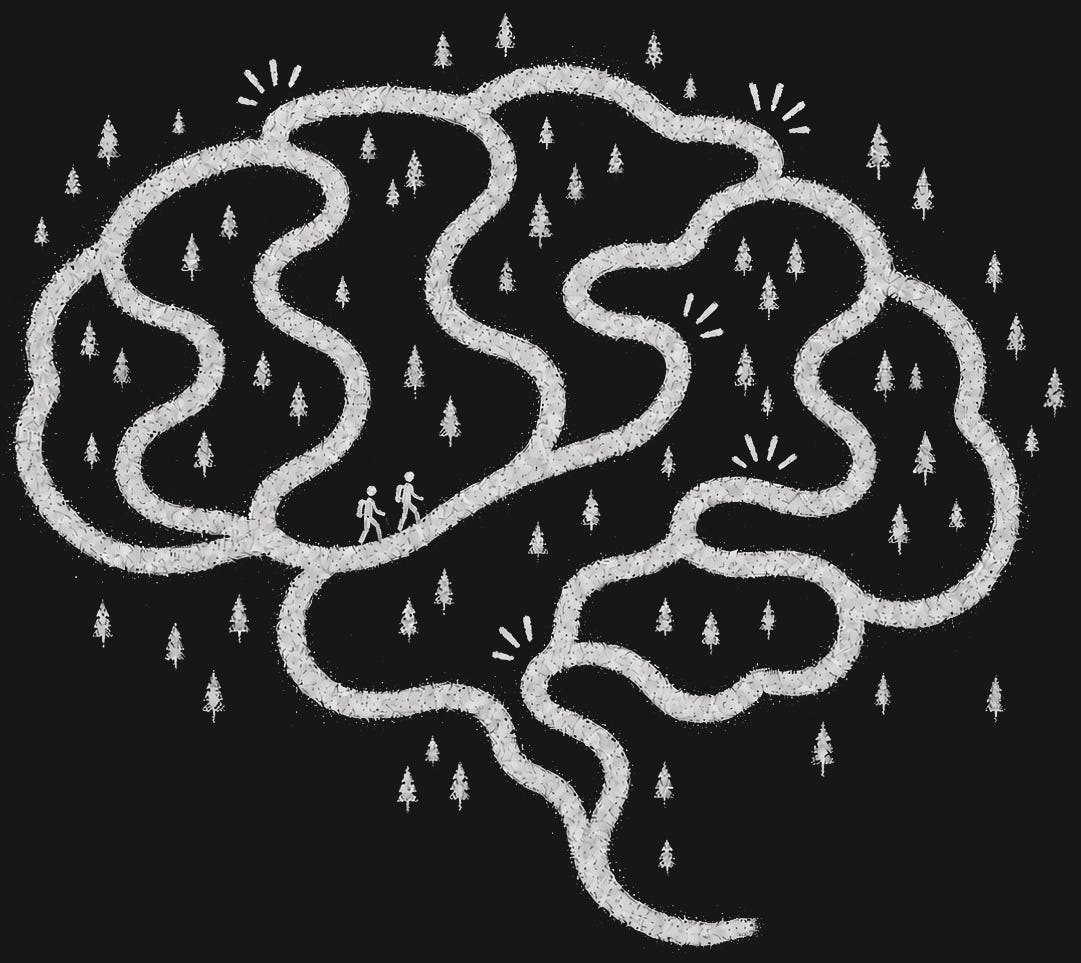
Getting out of the lab or office and doing something else is a key creative step in the scientific process. Most scientists we’ve met recognize the power of a long walk and know when to wander alone with their thoughts and when to walk and talk with a colleague. Walks are one of the most common versions of this, but not the only one. Dan and his grad-school roommate once solved a thorny problem in her colloidal crystal research while they were in the kitchen making breakfast.
This effect is well-known enough that corporations are continually willing to invest large sums of money to incorporate natural features and other informal spaces into their R&D campuses. Bell Labs and IBM’s TJ Watson Research Center are the classic US examples, but Huawei’s Oxhorn Campus (completed 2019) LG’s Science Park (completed 2018) and Novartis’s Shanghai Campus (completed 2016) include similar investments. And of course universities also invest heavily in creating and maintaining similar environments, though they serve many purposes at once.
Employers of scientists are willing to spend substantial amounts of money to give them space and time to hang out and take walks. Scientists themselves know that stepping away from their work is a valuable use of their time and an important contributor to their overall productivity. But we don’t have any tools to improve the effectiveness of these interventions. Meanwhile, AI for Science companies are automating literature searches and lab drudgery without regard for the creative processes needed to decide what to read and what to study. No matter how sophisticated machines become at generating and testing hypotheses, science is for humans and so there will always be a role for human creativity in deciding what to work on and why it matters. AI and physical automation may free up some hours for that creativity, but the entire field is currently missing the opportunity to improve our creative hours as well.
So what would it look like to augment thinking while walking? Probably a real-time voice assistant so the walk won’t be disrupted. The assistant could capture and follow up on leads so that detailed analysis is available at your desk when the walk is done. It could provide memory and continuity, reminding you what ideas you’ve considered in the past and offering relevant experimental details and data. It could even kick off relevant experiments back at the robot laboratory and report on the results in real time.
This is a new version of one of the oldest dreams of industrialization: by increasing the value of creative thinking and lowering the cost of non-creative activities, we can carve out more time for those creative activities. In the same way that pencil drafting is no longer part of engineering, what tasks will we let go of from science and never miss? So, AI for science folks, we challenge you to present a utopian vision for the life of a scientist. Can our work be indistinguishable from hanging out in nature with our friends? Can AI assistants connect us to our tools and to each other spontaneously as needed? Can we generate so much value for the world that building us parkland to thrive in becomes an obvious choice?
We write Reinvent Science to broaden the conversation around science and science funding, and we rely on you to help us reach as many readers as possible. Please support our work by subscribing and sharing.
This general theme reminds me of what night science is doing - looking at ways to promote creativity in science.
https://night-science.org/